
Building a profitable retail business in the UK really comes down to making smart buying decisions. When you tap into bulk buying for resale, you’re giving yourself access to prices that regular buyers never see, which can make a huge difference to your overall margins.
With so many fast-moving trends and new products hitting the market, sourcing the right items at the right price has never been more important.
This guide breaks down how bulk buying works in the UK, where to find trustworthy suppliers, and how to use volume discounts to create a stronger, more sustainable retail business.
What is Bulk Buying for Resale?

Bulk buying for resale is the foundation of almost every retail business. It’s the process of purchasing a high volume of goods (your inventory or stock) directly from a manufacturer, distributor, or specialist wholesale supplier.
This is done with the express intention of selling those items individually or in smaller bundles to the final consumer at a marked-up price.
The core of this strategy lies in the unit cost. When you purchase 1,000 units of a product instead of just 10, the supplier gives you a significant volume discount. This is due to the supplier's own economies of scale.
Is Bulk Buying for Resale Profitable?
Yes, bulk buying for resale is highly profitable, provided you focus on sourcing in-demand items. Buying in bulk significantly lowers your per-unit costs, allowing you to resell the items at strong margins.
Many product categories offer gross profit margins between 40% and 75% when inventory is sourced wisely and priced competitively.
Understanding Profitability (Directly from Wholesale Sourcing):
The profitability of the bulk buying model is a direct result of the cost structure:
Maximum Discount
Wholesalers and manufacturers offer deep discounts because they profit from moving large volumes quickly, reducing their inventory holding costs. These B2B (Business-to-Business) discounts provide the initial financial advantage to the reseller.
Controlling the Cost of Goods Sold (COGS)
When a reseller secures lower COGS through bulk purchases, they gain much more flexibility in how they price the product. For instance, if a reseller pays £5 wholesale and sells the item for £12, that £7 difference works out to a 58% gross margin.
A margin like this usually covers operating costs (such as storage, marketing, and delivery) while still leaving a solid net profit.
The Scalability Factor
Buying in high volumes gives small businesses the chance to grow quickly without constantly renegotiating prices. Once you lock in a strong wholesale rate, the wholesale channel becomes more predictable and financially worthwhile.
The core principle remains: the larger the gap between your discounted wholesale cost and your retail price, the greater your profit potential.
What are the Advantages of Bulk Buying?
The practice of bulk buying for resale in the UK is a core growth strategy for small and medium-sized enterprises (SMEs) because of the extensive operational and financial advantages it offers.
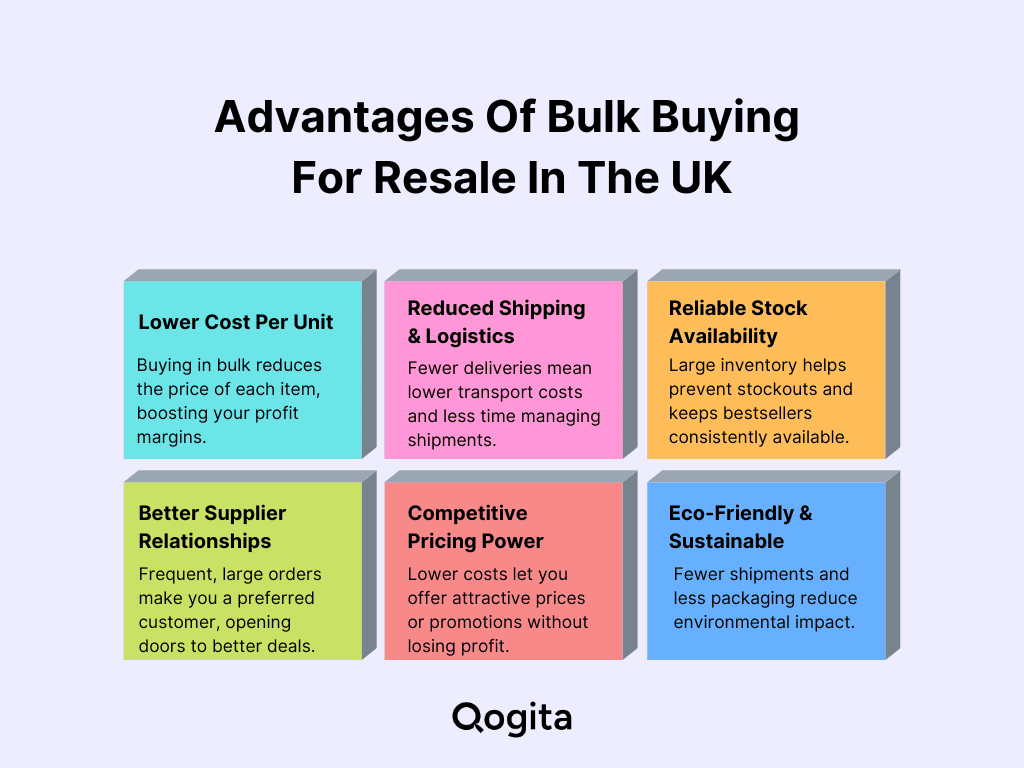
Maximised Cost Savings and Profit
The most significant benefit is the reduction in the cost per unit. Wholesale suppliers offer volume-based discounts (often 20% to 50% lower than smaller retail trade prices), which directly widens your profit margin. This cost saving is crucial for staying competitive in the UK market.
Reduced Logistics and Delivery Costs
Purchasing a single large shipment rather than multiple small ones dramatically reduces overall shipping and handling fees. The delivery cost is spread across thousands of units, making the logistics cost per item negligible.
Furthermore, it saves significant administrative time spent on tracking multiple orders and invoices.
Ensured Stock Reliability (No Stockouts)
Having a large inventory means you are far less likely to run out of stock on your best-selling items. This consistency is vital for customer satisfaction and avoiding lost sales, particularly during peak UK trading seasons like Christmas or Bank Holidays.
Stronger Supplier Relationships
A reseller who consistently places large, reliable orders becomes a priority customer. This can lead to better negotiation leverage, the offer of extended payment terms, and even exclusive access to new or limited-edition products before your competitors.
Competitive Pricing Power
With a lower cost base achieved through bulk discounts, your business can offer highly competitive pricing or run compelling promotions without sacrificing profitability. This is a very powerful tool for attracting and retaining price-sensitive customers.
Sustainability Benefits
Buying in large shipments reduces the number of trips and the overall amount of packaging materials used (fewer boxes and plastic inserts). For eco-conscious UK shoppers, this reduction in the supply chain's carbon footprint can be an attractive selling point.
What are the Disadvantages of Bulk Buying?
While the promise of low unit cost is attractive, bulk buying for resale in the UK comes with significant risks that can severely impact a small business if not managed properly.
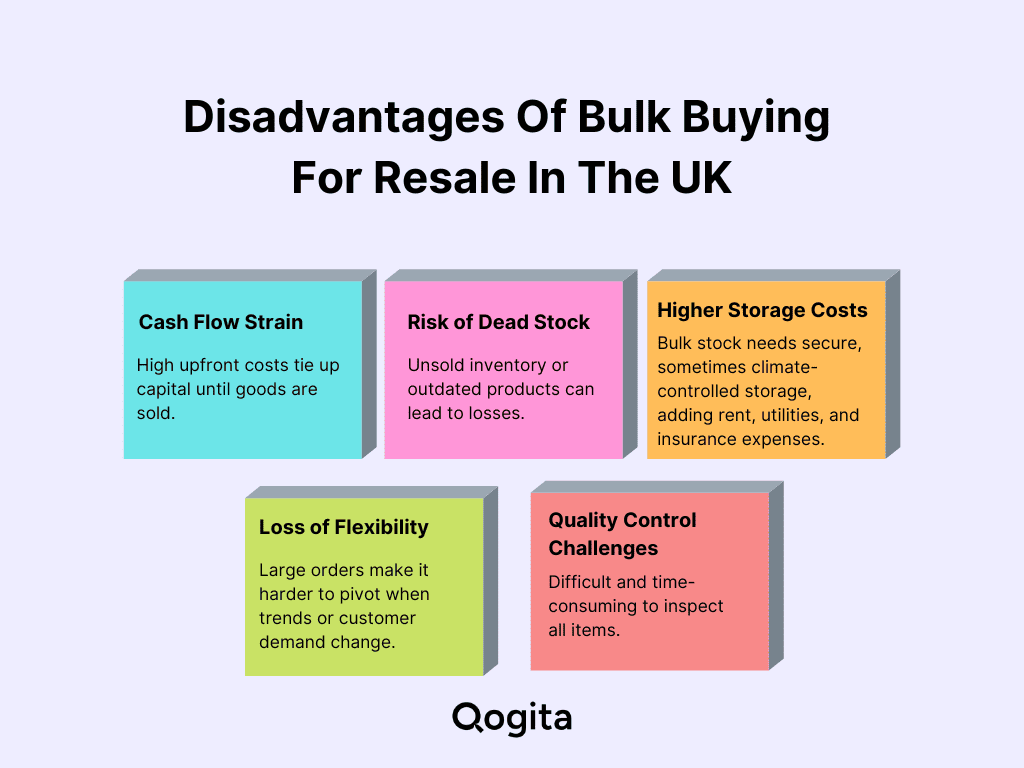
Cash Flow Strain (Capital Tie-Up)
The largest hurdle is the high upfront cost. Purchasing thousands of units ties up a large amount of working capital. This money is tied up in inventory until the goods are sold, which can limit your business's ability to invest in marketing, new product development, or essential operational needs.
Risk of Dead Stock and Obsolescence
If you overestimate demand or market trends change quickly, you can end up with 'dead stock' (inventory that won't sell). This stock not only represents a sunk cost but also increases the risk of loss, especially for products with short shelf lives (such as food or cosmetics) or rapid innovation cycles (such as electronics).
Increased Storage and Carrying Costs
Bulk stock needs proper storage that’s secure, spacious, and sometimes even climate-controlled, which means additional costs for rent, utilities, insurance, and security. These "carrying costs" can easily erode the savings achieved through wholesale discounts.
According to inventory management experts, carrying costs typically range from 20% to 30% of the total inventory value annually.
Loss of Flexibility and Agility
Committing to a massive order of a single product type can make your business slow to respond to market shifts. If a competitor releases a better product or a new trend emerges, a large inventory prevents you from quickly pivoting your stock offering.
Quality Control Challenges
When you’re dealing with a large delivery, checking every single item for defects becomes difficult and time-consuming. That makes it easier for a faulty product to slip through, which can lead to returns, unhappy customers, negative reviews, and damage to your brand’s reputation.
How to Find Suppliers for Reselling?
Finding reliable suppliers is the most critical step for your resale business. Your profit margins, product quality, and stock consistency all depend on securing strong sourcing relationships.
Here are the most common and effective ways to find wholesale suppliers in the UK:
1. B2B Wholesale Marketplaces

These modern platforms act as a centralized hub, connecting retailers with multiple verified wholesalers, distributors, and brands. They streamline the ordering process, which is especially beneficial for small businesses navigating the complexities of bulk purchasing.
One prominent example is Qogita, Europe's B2B Wholesale Marketplace specializing in Health & Beauty products.
Qogita offers key advantages:
- Lower Minimum Order Value (MOV): Traditional wholesalers often require minimum orders of €10,000 or more. Qogita negotiates with suppliers on your behalf, giving smaller retailers access to bulk pricing with MOVs starting from just €300.
- Centralized Sourcing: You can compare offers from a combined catalog of over 500 vetted suppliers and 10,000+ brands in one place, saving you the time of managing multiple contracts.
- Authenticity Guarantee: Qogita sources only from trusted suppliers, which is essential for meeting resale and compliance requirements on platforms like Amazon. Their invoices are also designed to match strict third-party marketplace standards.
2. Trade Shows and Fairs
Attending industry trade shows, such as the Spring Fair or Autumn Fair in the UK, gives you the chance to meet suppliers face-to-face, review product samples, and discuss terms directly. This kind of in-person interaction can help you build stronger relationships than online sourcing alone.
3. Direct from the Manufacturer/Brand
For established brands or high-volume items, contacting the manufacturer or official brand distributor directly is often the best route to get the absolute lowest price. However, they frequently have the highest Minimum Order Values (MOVs) and stricter application processes.
4. Wholesale Directories
Online directories like eSources and The Wholesale Forums list verified UK and international suppliers across many different niches. They’re a helpful place to start your search, but you still need to vet every supplier yourself.
5. Local Cash & Carry Wholesale Warehouses
For some products, especially fast-moving consumer goods or food items, local cash-and-carry warehouses let you buy in bulk right away without placing an order in advance. The prices can be a bit higher than going through a direct wholesaler, but it’s a convenient way to restock quickly with very little commitment.
6. Clearance and Liquidation Sources
These are high-risk, high-reward options for sourcing goods well below market price. You can find specialist Job Lot websites that sell returned or surplus stock from large retailers. The inventory is often unpredictable, but the profit potential is high if you know how to identify quality stock.
What to Consider Before Getting Started Reselling in Bulk
Successfully transitioning to bulk buying for resale UK requires careful planning to mitigate the risks of high upfront costs and dead stock. Before placing your first large wholesale order, ensure you have a firm strategy for the following:
Market Research and Niche Validation
Do not buy stock just because the price is low. You must validate the demand first.
- Identify Your Niche: Focus on a clear product category, such as sustainable pet supplies or specialty beauty tools, and then use tools like Google Trends or marketplace data to make sure there’s steady or growing demand.
- Analyse Sell-Through Rate: Use sales data (from competitors or similar items) to estimate how quickly your stock will sell. A slow sell-through rate, even with cheap bulk stock, will cause serious cash flow problems.
- Price Competitiveness: Calculate the total cost of an item (wholesale price + delivery + marketplace fees) and determine if you can still sell at a competitive price while maintaining your target 40%+ profit margin.
Legal and Tax Compliance
Reselling goods purchased in bulk is a formal business activity in the UK, not a hobby.
- Register Your Business: You must register with HM Revenue & Customs (HMRC) as a Sole Trader or form a Limited Company. You are required to declare profits through an annual Self-Assessment tax return.
- VAT Registration: If your annual taxable turnover exceeds the UK threshold (currently £90,000 for the 2024/25 tax year), you must register for VAT. This is essential for serious resellers.
- Consumer Protection: As a reseller, you are legally responsible for the products you sell under the Consumer Rights Act 2015. All goods must be "of satisfactory quality, fit for purpose, and as described."
Storage and Logistics
The savings from bulk buying can be wiped out by poor inventory and storage planning.
- Secure Storage: Determine where the physical stock will be safely stored. This could be a spare room, a self-storage unit, or a Third-Party Logistics (3PL) warehouse. Factor in the cost of rent, insurance, and utilities.
- Fulfillment Strategy: Decide whether you’ll handle picking, packing, and shipping yourself or use a service like Amazon FBA or another 3PL provider. Outsourcing fulfillment can save you time, but it does increase your cost per unit.
- Inventory Tracking: Implement a robust tracking system (a simple spreadsheet or specialized inventory management software). This must track the quantity, location, and cost of every unit to prevent overselling and inform reordering.
Is Bulk Buying Cheaper in the UK?
Yes, bulk buying is fundamentally cheaper per unit in the UK than purchasing items at standard retail prices (only when you buy through legitimate wholesale channels).
The cost-benefit is not an assumption but an embedded part of the supply chain economy.
Real-World Unit Cost Difference (Consumer Example):
While the figures for B2B wholesale are private, consumer data from the UK often mirrors the unit-cost savings principle.
A UK government analysis on unit pricing noted that for staples like milk, buying a 4-pint bottle made the unit price nearly 60% cheaper than purchasing a 1-pint bottle.
The same idea applies to non-perishable goods and everyday household products. Buying these items in bulk usually delivers meaningful savings, with per-unit discounts ranging from 25% to 50% or more when compared to smaller retail packs.
Across a wide range of products, the average savings come out to around 27%, and for certain items, the discount can climb well beyond 50%, showing just how cost-effective volume purchasing can be.
For a reselling business, leveraging the full B2B wholesale pricing system means the price difference is even more dramatic and essential for profitability.
Can I Buy Wholesale for Personal Use in the UK?
The answer is generally no. While there are no UK laws making it illegal for an individual to purchase goods in bulk, the vast majority of true wholesale suppliers will only sell to registered businesses buying for resale.
Wholesalers operate on a Business-to-Business (B2B) model for two main reasons:
1. Protecting the Supply Chain: Their business is to supply retailers, not compete with them. If they sold at wholesale prices to the general public, they would undercut their own retail customers, destroying their business model.
2. Trade Verification and Tax Compliance: Wholesalers need to verify that their customers are legitimate traders for their own accounting and tax records. They typically require proof of trade status, such as:
- A registered business name (Sole Trader or Limited Company).
- A VAT number (if VAT registered).
- A trade account application.
- A trade card (common with Cash & Carry wholesalers like Booker).
So, while you can access certain cash-and-carry warehouses for personal use, they typically do not offer the deeply discounted pricing required to run a profitable resale business.
Conclusion
Bulk buying for resale in the UK is a foundation for any retailer that wants long-term growth. It gives you access to deeply discounted wholesale prices, which are important for reaching strong profit margins that often fall between 40% and 75%.
The process does require planning because you need to manage cash flow, organise storage, and choose suppliers carefully, but the benefits are usually worth the effort.
Focus on products with clear demand, keep your inventory organised, and make sure you operate as a registered trader so you can make the most of buying in bulk.
Bulk Buying for Resale FAQs
What Products Can I Buy Low and Sell High?
Focus on products that sell steadily throughout the year or show strong growth, such as health and beauty items like skincare or supplements, tech accessories like chargers and smart gadgets, and everyday pet supplies. Try to choose niche, consumable products that customers need to buy again and again because this helps you maintain consistent sales.
Is Bulk Buying for Reselling Worth It?
Absolutely, as it is the foundation of profitability. Bulk buying for resale UK allows you to secure unit costs that are typically 20% to 50% lower than non-trade prices, creating the necessary gross profit margin (often 40% to 75%) to cover business expenses and generate net profit.
Where Can I Buy Cheap Wholesale Products to Resell?
Use specialized B2B wholesale marketplaces (like Qogita or Faire), attend UK trade shows (like the Spring Fair), or source directly from the manufacturer/official distributor. Clearance and liquidation sources offer the lowest prices but often carry higher risks regarding stock quality.
How Much Profit Can I Make Reselling Bulk Items?
Successful UK resellers generally aim for a gross profit margin of 40% to 60% on their items. The calculation is: Gross Profit = Retail Price – Cost of Goods Sold (including wholesale price and all delivery costs). High volume sales amplify this per-unit profit into substantial revenue.
What Marketplaces Are Best for Reselling Bulk Items?
Marketplaces like Amazon and eBay give you access to huge numbers of buyers and work well for almost any type of product. If you sell more specialised items, you can look at platforms like Etsy for handmade or vintage goods, OnBuy for a seller-friendly general marketplace, or a niche site like Not On The High Street for gift-focused products.