
Selling cosmetics in the European Union is a big business opportunity for retailers, but it requires following a set of strict rules. The main law is Regulation (EC) No. 1223/2009, which outlines the comprehensive EU cosmetic regulations. This framework ensures all products sold across the 31 European countries are safe and clearly labeled for consumers.
To succeed, you must understand the key steps: finding a Responsible Person, preparing essential safety files, and correctly notifying authorities.
In this guide, we will walk you through all the mandatory requirements for selling cosmetics in the EU.
Defining a Cosmetic Product in the EU
Before you sell anything, you must confirm that your product is legally considered a cosmetic product under EU law. Regulation (EC) No 1223/2009 defines a cosmetic as any substance or mixture intended to be applied to the external parts of the human body. This includes the skin, hair, nails, lips, external genital organs, teeth, and the mucous membranes of the oral cavity.
The purpose of the product must be exclusively or mainly to:
- Clean them
- Perfume them
- Change their appearance
- Protect them
- Keep them in good condition
- Correct body odours
This definition covers traditional makeup and fragrances, plus personal care items like lotions, soaps, deodorants, hair care products, and sunscreens. Products administered via ingestion, injection, or inhalation are not cosmetics.
You must carefully assess your product's purpose to ensure it fits the EU cosmetic definition and complies with the correct EU cosmetics regulations.
Who Is the Responsible Person in EU Cosmetic Regulation?
Every cosmetic product sold in the EU must have a designated Responsible Person (RP). This person or company must be established within the EU itself. The RP is the single most important part of your compliance.
So, who is the responsible person in the EU cosmetics regulation?
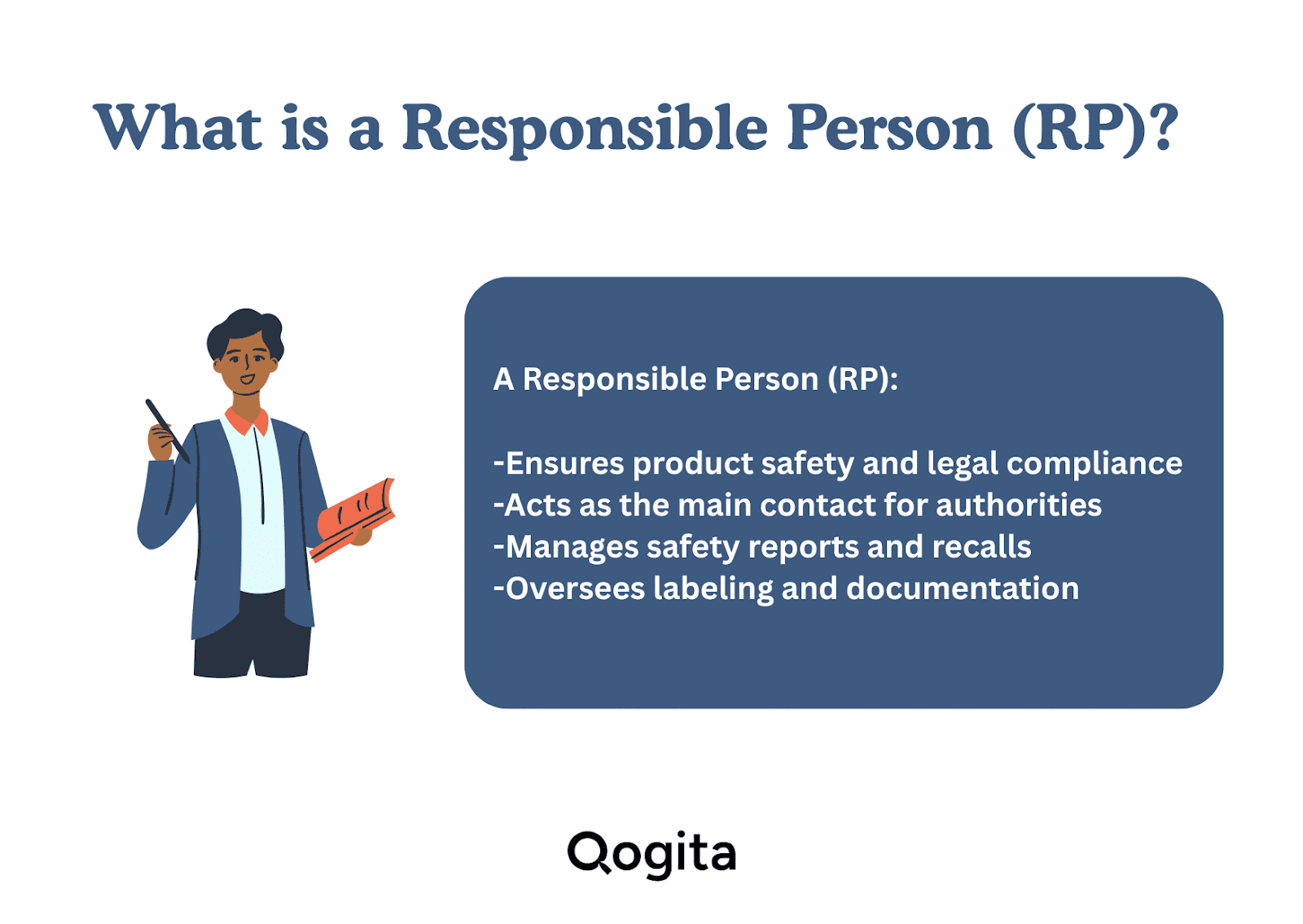
The RP can be the manufacturer, the importer, the distributor, or a specialized third-party consultant you hire. If your brand is based outside the EU (like in the US), you must appoint an RP based in Europe. Also, it's mandatory to show the name and address of the RP on the product label.
The RP carries the full legal responsibility for ensuring your product meets all EU cosmetic regulations. Their main responsibilities include:
- Compiling and storing the Product Information File (PIF) for 10 years after the last product batch is sold.
- Submitting the product notification through the CPNP system.
- Conducting post-market surveillance (watching for and reporting serious side effects).
- Providing all documentation to regulatory authorities upon request.
Appointing a professional RP is the best choice you can make to guarantee compliance and protect your business.
The Pillars of EU Compliance: Step-by-Step Process
Complying with EU cosmetic regulations involves many mandatory steps that ensure every product sold in the European Union meets strict safety and transparency standards. Regulation (EC) No 1223/2009 lays out the complete compliance process, from ingredient review to post-market monitoring.
Each stage is designed to confirm that a cosmetic product is safe for human use, properly documented, and traceable once it reaches consumers.
Step 1: Ingredient Compliance and Formula Review
One of the biggest differences when selling in Europe is how the EU controls ingredients. The EU uses a very strict positive and negative list system, which is different from many other markets. This means that if an ingredient isn't on an approved list or if it is on a banned list, you cannot use it in your products.
Key Ingredient Rules:
- Prohibited Substances (Annex II): You must strictly avoid any substance listed in Annex II. This includes all substances classified as CMR (Carcinogenic, Mutagenic, or toxic to Reproduction). If a substance is banned, you cannot use it at all.
- Restricted Substances (Annexes III–VI): Many common ingredients, such as certain colorants, preservatives, and UV filters, can only be used under specific conditions. You must follow the exact limits on concentration, the type of product they are used in (e.g., body lotion vs. eye makeup), and any required warnings on the label.
- Animal Testing Ban: The EU strictly prohibits the sale of any cosmetic product where the final product or its ingredients were tested on animals to meet EU safety data requirements if the testing occurred after March 11, 2013.
As a retailer, you need to ensure your manufacturer provides proof that every ingredient in your formula complies with these strict conditions under the EU regulations on cosmetics.
Step 2: The Product Information File (PIF)
The Product Information File (PIF) is the master document that contains all critical safety and compliance data for your product. It’s the proof that your product meets the EU Cosmetic Regulations (1223/2009).
The Responsible Person (RP) is legally required to compile this file and keep it updated and accessible for ten years after the last batch is sold.
The PIF must contain several key elements:
- Detailed Product Description: What the product is and what it’s used for.
- Cosmetic Product Safety Report (CPSR): This is the most valuable part. It must be prepared by a qualified Safety Assessor (trained in pharmacy, toxicology, or chemistry).
- Part A: The safety information (ingredients, exposure data, etc.).
- Part B: The safety assessment itself, including the assessor’s conclusion that the product is safe.
- Manufacturing Process Details: Proof that the product was made following Good Manufacturing Practices (GMP), often shown by compliance with ISO 22716.
- Proof of Claims: Data (in-vivo or in-vitro test results) that prove every claim you make about the product’s effects.
- Testing Data: Results from stability tests (to define the expiry date) and preservative efficacy testing (challenge tests), ensuring the product is safe over its declared shelf life.
- Animal Testing Data: If you did any test outside the EU to meet non-EU rules, include that data also.
Step 3: Notification via CPNP
Once your product is safe, compliant, and documented in the PIF, the final mandatory pre-market step is notification. This is done through the Cosmetic Products Notification Portal (CPNP).
The CPNP is the EU’s official online system for providing information about the cosmetic products you place on the European market. The Responsible Person must complete the notification before the product is sold. This allows EU control authorities (and poison centers) to access product details quickly in the event of an emergency.
What to Report to CPNP:
- Product Details: Category, name, and the first EU country of launch.
- RP Information: The name and address of the Responsible Person and the location where the PIF is stored.
- Formula: A "frame formulation" that helps emergency response teams understand the product’s general composition.
- Packaging and Labeling: Photos of the packaging and label artwork.
- Special Ingredients: Identification of ingredients that are nanomaterials or CMR substances (if present).
Special Rule for Nanomaterials:
If your product contains nanomaterials (insoluble, intentionally manufactured materials between 1 and 100 nm), you have to submit an additional, separate notification to the CPNP.
This special report must be done at least six months before you intend to market the product. It gives authorities time to review the safety data for these tiny particles.
What Are The EU Labeling Requirements For Cosmetics?
Clear and correct labeling is mandatory under Article 19 of the EU Cosmetic Regulation 1223/2009. You must print the information on the label in easily readable, visible, and unforgettable lettering. Getting the label right is important for avoiding recalls.
Here is the mandatory information that must appear on your product's packaging:
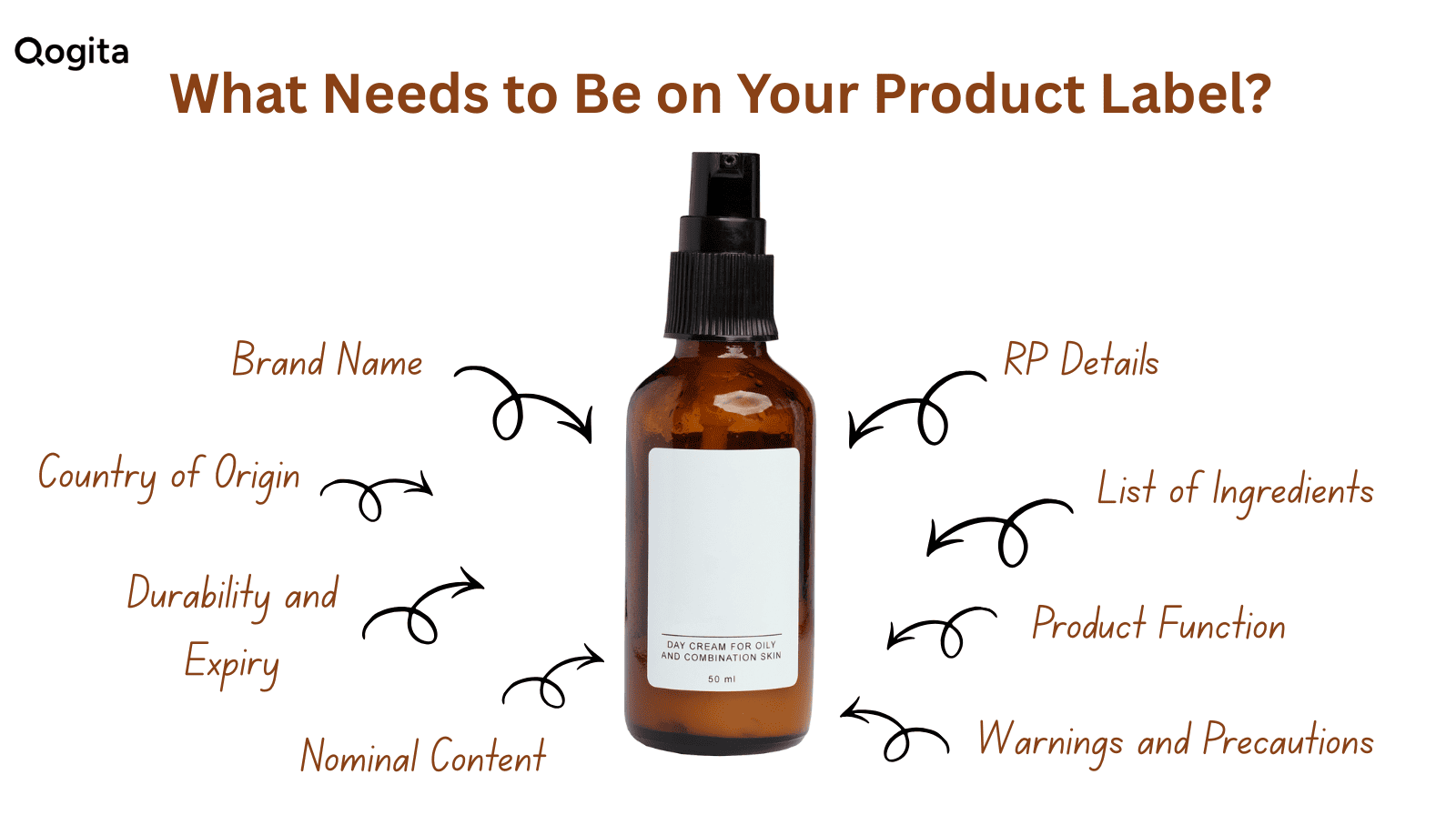
- Responsible Person (RP) Details: As mentioned earlier, you must print the name and address of your RP (based in the EU) on the label.
- Country of Origin: For products imported from outside the EU, the country of origin must be printed.
- Nominal Content: The amount of product (weight in grams (g) or volume in milliliters (ml)). This must be the first unit shown.
- Durability and Expiry: If the shelf life is 30 months or less, you must show the Date of Minimum Durability (DOMD) using the hour-glass symbol and the date (MM/YYYY).
If the shelf life is more than 30 months, you must show the Period After Opening (PAO). This uses the open-jar symbol with a number inside (e.g., 12M for 12 months).
- Warnings and Precautions: Any specific instructions for safe use (e.g., "avoid contact with eyes").
- Batch Number: A code that allows you to trace exactly when and where the product was made.
- Product Function: A clear description of what the product does (e.g., "hand moisturizer") to prevent misuse.
- List of Ingredients: All ingredients must be listed using their INCI (International Nomenclature of Cosmetic Ingredients) names, in decreasing order of weight. Ingredients below 1% can be listed in any order after those above 1%.
Important Translation Rules:
To comply with EU cosmetics regulations, you have to provide all mandatory labeling information in the official language(s) of the EU member state where the product is sold.
For example, in France, labeling must be in French, while in Germany, it must be in German. We do this to make sure that consumers in each country can easily understand the product’s details.
Text must also be clearly visible, legible, and indelible. Fonts should not be too small or faint, and information should not be obscured by graphics or packaging design. This standard applies to both primary and secondary packaging.
Labeling of Nanomaterials:
If a cosmetic product contains nanomaterials, their presence must be clearly indicated on the label by adding the word “(nano)” immediately after the ingredient name. It is very important because nanomaterials have unique properties and require extra scrutiny for safety.
For example, “Titanium Dioxide (nano)” identifies that the ingredient is used in nanoparticle form, which allows regulators and consumers to recognize it instantly.
Labeling for Small Products and Special Cases:
If your packaging is too small (such as a small vial or ampule), you can use a leaflet, tag, or card to display some mandatory information. In this case, you must print the "hand-in-book" symbol on the primary packaging to tell the consumer that more information is enclosed.
The Truth in Marketing: Cosmetic Claims Regulation
While labeling covers the basic facts, cosmetic claims relate to how you advertise and market your product. To maintain consumer trust and market fairness, the EU cosmetic regulations include specific rules for claims found on labels, websites, or in ads. This is detailed in Regulation (EC) No 655/2013, which is dedicated to claims.
The goal is to make sure the information given to customers is useful, reliable, and understandable, allowing them to make informed decisions when choosing a product. You cannot mislead your customers.
The Six Legal Criteria for Claims:
All claims about your cosmetic product must comply with these six standards:
- Legal Compliance: The product must fully comply with all EU laws, especially Regulation 1223/2009.
- Truthfulness: Claims about the product's composition or effects must be factually correct. You cannot claim an effect that isn't true.
- Evidential Support: Every effect or benefit you claim (e.g., "reduces wrinkles," "hydrates for 24 hours") must be backed up by proof, such as scientific data, testing results, or published literature.
- Honesty: Claims must not imply that the product has unique features when, in fact, all similar products share those features.
- Fairness: Claims should not discredit or unfairly compare your product to a competitor's.
- Informed Decision-Making: The language used must be clear so the average consumer can understand the benefit and choose the product that meets their needs.
These six criteria ensure that all cosmetics sold in the EU are marketed in a way that is transparent, verifiable, and ethical.
Evidence and Documentation Requirements
EU cosmetics regulations require brands to back every product claim with solid evidence in the Product Information File (PIF). They must include proof from lab tests showing performance, consumer studies tracking real results, or scientific research supporting the claim.
For example, if a cream claims to “reduce wrinkles within two weeks,” there must be test data showing measurable wrinkle reduction over that period. Authorities may request access to this documentation at any time, and the burden of proof lies entirely with the Responsible Person or manufacturer.
Prohibited and Restricted Claims
The cosmetics regulations framework bans certain types of claims that can mislead or sabotage consumer safety. These include:
- Medical or therapeutic claims: Cosmetics cannot claim to treat or cure diseases or medical conditions. Such statements would classify the product as a medicinal product under EU law.
- “Free from” claims: Phrases like “free from parabens” or “free from preservatives” shouldn’t be used unless they genuinely help consumers understand the product better. If such claims imply that other products containing those ingredients are unsafe, they are considered misleading.
- “Hypoallergenic” claims: These can only be used if the product has been formulated to minimize the risk of allergic reactions, and this can be supported by scientific evidence.
- Misleading visuals or wording: Images, colors, or language suggesting unrealistic outcomes (for example, “instant facelift”) are non-compliant unless verifiable through data.
Green and Sustainability Claims
Sustainability-related marketing has become increasingly common these days, but it also falls under the scope of EU regulations on cosmetics.
Claims such as “eco-friendly,” “biodegradable,” or “natural” must be supported by data, including lifecycle analyses or certification from recognized environmental bodies.
Brands are expected to avoid vague “greenwashing” statements that they cannot back up with measurable facts. For example, saying a product is “environmentally safe” without explaining how is not sufficient under EU cosmetics regulations (1223/2009) and Regulation 655/2013.
Current and Future Trends in EU Regulations on Cosmetics (Recent Amendments)
The EU regulations on cosmetics are constantly being updated to improve safety. As a retailer, you must stay informed about new amendments, bans, and restrictions, as these changes require you to reformulate products, update the PIF, and relabel quickly.
Key recent and upcoming regulatory changes include:
Revision of the Core Regulation
The European Commission published Commission Regulation (EU) 2025/877, which amends the original Regulation (EC) No. 1223/2009. From September 1, 2025, this update has introduced new rules to manage potentially toxic or harmful chemicals in cosmetics, especially focusing on CMR substances.
Targeted Bans and Restrictions (2024/2025)
The EU has placed even stricter limits on several groups of ingredients:
- Nanomaterials: Commission Regulation (EU) 2024/858 bans certain nanomaterials and restricts others, such as nano-hydroxyapatite.
- Retinoids and Preservatives: Regulation (EU) 2024/996 sets new bans (e.g., 4-methylbenzylidene camphor) and tightens restrictions on popular ingredients. For example, retinol, retinyl acetate, and retinyl palmitate will have concentration limits (e.g., maximum of 0.05% in body lotion and 0.3% in other products), effective November 1, 2025. Preservatives like triclosan and triclocarban are also restricted further.
- Omnibus Act VII: This draft legislation bans additional cosmetic substances that have been newly classified as CMR.
Amending REACH (D4, D5, D6)
Commission Regulation (EU) 2024/1328 amends the REACH chemical law to restrict the use of siloxanes D4 (Cyclotetrasiloxane), D5 (Cyclopentasiloxane), and D6 (Clohexasiloxane). After June 6, 2026, companies cannot place these substances on the market if their concentrations exceed 0.1% by weight.
When a substance gets banned, manufacturers must find which products contain it, change their formulas, update the PIF and CPNP details, and make sure any old stock is either sold or recalled before the deadline.
What Is The Difference Between US and EU Cosmetic Regulations?
While both the US (regulated by the FDA) and the EU want products to be safe, their approach to regulation is very different. The EU follows a precautionary principle, meaning that if an ingredient might be harmful, it is restricted or banned until proven safe. The US has traditionally been less prescriptive.
Here are the main differences:
Conclusion
Mastering the EU cosmetic regulations (1223/2009) demands dedication, but preparing those safety checks and PIF documents is your best investment. The cost of compliance is far lower than the financial and reputational damage of a single recall.
To truly protect your brand, you must ensure every product you source is 100% authentic and safe. Qogita simplifies this by guaranteeing authentic wholesale cosmetics from vetted suppliers.
This reliability lets you focus fully on your main legal duties: managing the PIF, handling CPNP notifications, and successfully fulfilling your role as the Responsible Person.