
In 2026, scaling a product business often means moving beyond selling one-on-one to individuals. To grow, you need to sell in bulk, which requires a solid wholesale pricing strategy.
If your price is too high, retailers won’t touch your product because they can’t make a profit. If it’s too low, you’ll be working around the clock just to break even. Finding that "sweet spot" is the difference between a struggling side hustle and a thriving brand.
In this guide, we will break down the exact formulas and strategies you need to price your products.
What is Wholesale Price?
At its core, wholesale price is the amount a manufacturer or distributor charges a business (the retailer) for products bought in large quantities. Unlike selling a single item to a person on the street, wholesale is a business-to-business (B2B) transaction.
The primary goal of wholesale pricing is to earn a profit by selling at a price higher than the cost of production, while remaining low enough that the retailer can still add their own markup.
You are essentially trading a higher profit-per-item for a higher volume-per-sale. Instead of spending your marketing budget to find 100 individual customers, you find one retail partner who buys 100 units at once.
Wholesale vs. Retail Pricing
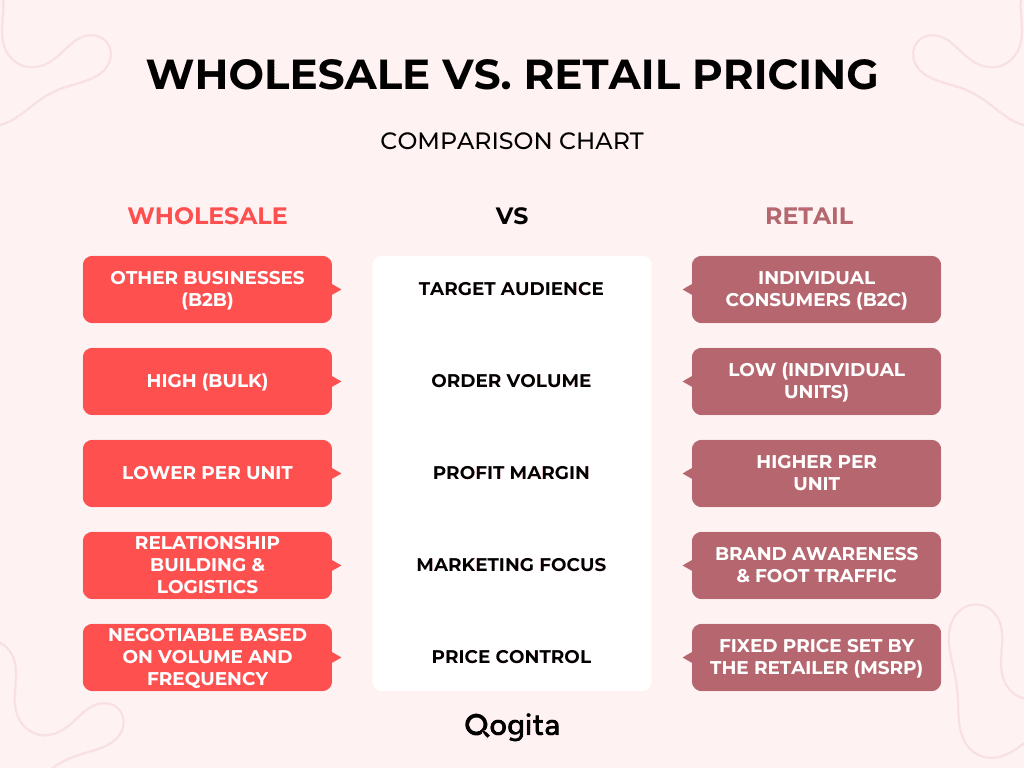
Understanding the difference between wholesale pricing vs. retail pricing is very important for your bottom line. While they involve the same product, the business models are fundamentally different:
- Wholesale Price: This is what the retailer pays you. It is built on the concept of economies of scale. Because the retailer is buying in bulk, you can afford to lower the price per unit. Your profit margins are typically smaller (usually between 20% and 50%), but your "cost per sale" is much lower because you are processing fewer, larger orders.
- Retail Price: This is the final price the end consumer pays. It is significantly higher because the retailer has to cover last-mile expenses, including store rent, sales staff, marketing, and the risk of unsold inventory.
The difference between these two prices is known as the retail margin. For example, if you sell a shirt for $20 wholesale and the retailer sells it for $50, that $30 gap allows the retailer to stay in business while bringing your product to a wider audience.
How to Calculate Wholesale Price
To figure wholesale pricing correctly, you need to follow a methodical, step-by-step process. Skipping even one of these steps can result in a price that either scares away retailers or leaves you losing money on every bulk order.
1. Research Your Market
Before looking at your own numbers, you need to understand the landscape. Your price tells a story about your brand.
- Identify Your Tier: Are you a discount brand, a contemporary brand, or a luxury label? A budget price for a luxury product can actually hurt sales because it signals low quality to retailers.
- Audience Expectations: If your target retailers serve budget-conscious customers, your price must leave room for them to offer a competitive retail price.
- Find Your Break-Even Point: Determine the minimum price you can charge just to cover costs. Knowing this floor ensures you never accidentally agree to a deal that costs you money.
2. Calculate Your Production Costs (COGM)
This is the most important step. You must determine your Cost of Goods Manufactured (COGM). This represents the total investment required to create a single product and get it ready for sale.
The COGM Formula:
Total Material Cost + Total Labor Cost + Additional/Overhead = COGM
- Materials: Every physical component, from raw ingredients to the final sticker on the box.
- Labor: The cost of the time spent manufacturing the product. Calculate the time spent per unit multiplied by the hourly wage. If you spend 30 minutes on a unit and pay yourself $20/hour, the labor cost is $10.
- Overhead: This includes rent for your production space, utilities, equipment depreciation, and even the software used to manage orders.
3. Set Your Desired Profit Margin
Your profit margin is the reward for your work and the capital you use to grow. When selling wholesale, you are moving higher volumes, which allows you to accept a lower margin than you would in retail.
- Standard Margins: In the wholesale world, aim for a profit margin between 15% and 50%.
- The Volume Trade-off: Remember, it is much more efficient to sell 500 units to one retailer at a 20% margin than to sell 500 units to individuals at a 60% margin, due to lower shipping and marketing efforts per unit.
4. Account for Operating Expenses
A common mistake is forgetting that your profit must also cover the costs of running the business, not just the costs of making the product. You need to factor in all these expenses:
- Fixed Costs: Rent, utilities, and software subscriptions.
- Variable Costs: Shipping and handling, merchant processing fees, and sales commissions.
- Customer Acquisition: What does it cost you in ads or trade show fees to land one new wholesale account?
Once you have these four steps finalized, you have the "Cost Price" needed to plug into a wholesale formula.
Wholesale Pricing Methods and Formulas
Once you have your costs and profit goals mapped out, you need a consistent formula to work out the wholesale price across your entire product line. Depending on your industry and how you want to position your brand, you will likely use one of these three methods.
The Keystone Pricing Method
The Keystone method is the most straightforward approach used in the retail and apparel industries. It relies on a simple 100% markup, essentially doubling your cost to reach the wholesale price.
The Formula:
Wholesale Price = Cost of Goods × 2
To better understand this wholesale pricing method, imagine you manufacture organic cotton T-shirts. If your total cost to make one shirt (COGM) is $10, your wholesale price becomes $20.
This method is popular because it is easy to calculate and usually leaves enough room for the retailer to double the price again for the consumer, reaching a $40 MSRP.
However, the downside is that it doesn't account for unique competitive pressures or fluctuations in your overhead.
The Absorption Pricing Method
The Absorption method is ideal for manufacturers who want to be mathematically certain that every single business expense is covered. Instead of a flat multiplier, this method absorbs" all production costs and operating expenses before adding a specific profit dollar amount.
The Formula:
Wholesale Price = (COGM + Operating Expenses) + Desired Profit Margin
For example, a small-batch hot sauce maker calculates that it costs $4.50 to produce a bottle and run the office. If they know they need exactly $2.50 profit per bottle to fund future growth, they set the wholesale price at $7.00.
This strategy ensures your profit is protected, provided you have accurately tracked every penny spent on utilities, rent, and insurance.
The Differentiated (Demand) Pricing Method
Differentiated pricing is a more fluid strategy used to figure out wholesale pricing based on market demand or buyer behavior. Rather than a fixed price for everyone, you adjust the rate to incentivize larger orders or to capitalize on peak seasons.
One of the most common applications of this method is the wholesale pricing discount B2B for bulk commitments. For instance, a soap manufacturer might charge a boutique $5.00 per bar for a small order of 20 units, but offer a "Tier 2" price of $4.00 per bar to a national distributor ordering 1,000 units.
This method also applies to seasonal demand. A wholesaler of luxury beach towels may set a higher price in early spring, when retailers are stocking up for summer, then offer a clearance wholesale rate in September to move remaining inventory and free up warehouse space.
Tips to Set Wholesale Prices
To finalize your pricing strategy, you need to look beyond the formulas and consider the long-term relationship with your retail partners. These practical tips will help you maintain your margins while making your brand more attractive to B2B buyers.
Set a Manufacturer’s Suggested Retail Price (MSRP)
An MSRP is the price you recommend retailers charge the end consumer. Providing this number is essential because it prevents retailers from undercutting each other and devaluing your brand. To calculate a fair MSRP, you can work backward from the wholesale price:
Formula:
Wholesale Price ÷ (1 - Markup Percentage) = MSRP
If you sell a leather wallet for $40 wholesale and want to ensure the retailer makes a 60% margin, your MSRP should be $100. Researching what similar brands charge at retail will help you ensure your MSRP is realistic for the market.
Google Shopping is the best tool for quickly comparing competitor retail prices to validate your MSRP.
Implement a Dual Pricing Strategy
If you sell both to retailers (wholesale) and directly to customers through your own website (DTC), you must use dual pricing. This means your website price should match the MSRP you give your retailers.
If you sell your own products on your site for $45 while your retailers are trying to sell them for $60, you are competing against your own partners. A dual strategy protects your B2B relationships by ensuring you don’t undercut the very people who help you grow.
Use Minimum Order Quantities (MOQs)
An MOQ is the lowest number of units a retailer must purchase to qualify for wholesale pricing. This is a vital tool for protecting your time and profit. For example, if it takes you two hours to pack and ship an order, it isn't worth doing for a 5-unit sale.
By setting an MOQ of 50 units or a minimum spend of $500, you ensure that every transaction is large enough to cover the administrative labor and shipping logistics involved in B2B commerce.
Strategically Align with Sales Volumes
In the wholesale world, volume is your best friend. You should align your pricing tiers with the volumes you want to sell. If you have an excess of a specific SKU, you can offer a volume kicker, a temporary discount for orders that exceed a certain threshold.
For instance, you can offer free shipping or an extra 5% discount on orders of 200 units or more. This keeps your inventory moving and rewards your most loyal high-volume buyers.
Conduct Regular Pricing Audits
Costs for raw materials, shipping, and labor are always shifting. A price that worked six months ago might be eating into your profits today.
Make it a habit to review your wholesale price list every quarter. If your cost of materials increases by even 5%, that loss is magnified across a bulk order of 1,000 units.
Regular audits let you make small, incremental price adjustments rather than a single, shocking price hike that might alienate your retailers.
Conclusion
Getting your wholesale pricing right is the difference between a real business and an expensive hobby. It protects your time, covers your overhead, and gives retailers a reason to buy your products.
Use the formulas we provided in this guide to set a price that works for your bottom line and your partners. Once your costs are locked in and your margins are set, you can stop second-guessing your numbers and focus on moving more inventory.
How to Calculate Wholesale Pricing FAQ
What is the simplest formula for wholesale price?
The most basic calculation is: Wholesale Price = Cost of Goods + Desired Profit Margin. Most businesses aim for a wholesale margin between 15% and 50%.
What is a good wholesale profit margin?
A healthy margin typically falls between 30% and 50%. This gives you enough profit to reinvest in the business while leaving the retailer enough room to add their own 50%-60% markup.
How does wholesale pricing differ from retail pricing?
Retail price is what the end user pays, while wholesale is the discounted price for businesses. Wholesale focuses on high-volume efficiency, whereas retail pricing covers the high costs of individual customer acquisition and storefront overhead.
What is the Keystone method?
It is a pricing strategy where you double your cost of production to reach your wholesale price, and the retailer doubles that wholesale price to reach the retail price.
Can I change my wholesale prices for different retailers?
Yes, this is called differentiated pricing. You can offer lower rates to retailers who buy in bulk or are long-term partners, as long as you maintain a consistent base price to protect your brand value.
How do I handle shipping costs in wholesale?
Most wholesalers use Ex Works (EXW) or Free on Board (FOB) terms, meaning the retailer pays for the shipping from your warehouse. However, some wholesalers offer free freight on orders over a certain amount to encourage larger purchases.