
Choosing the right business model is the first major hurdle for any e-commerce entrepreneur. Two of the most popular paths are private label vs wholesale. While both can lead to a profitable business, they require very different levels of capital, time, and skill.
The decision to sell wholesale vs. private label comes down to your current investment options, available resources, and your goals. Wholesaling can be a great way to get started by selling established products, while private label lets you create and scale your own brand from the ground up.
In this guide, we will break down both models to help you decide which path fits your business needs.
What is Private Label?
Private label is a business model where you source products from a manufacturer and sell them under your own brand name. Instead of selling a product that belongs to another company, you are the brand owner. You have the power to customize the product, design the packaging, and control the marketing.
When you use this model, you find a product that is already performing well or has high potential. You then work with a supplier to add your logo and unique features. This allows you to build a long-term asset that you fully control and own.
For example, imagine you find a manufacturer that makes high-quality yoga mats for €5 each. You ask them to print your brand logo on the mats and package them in custom boxes. You then sell these mats on your own website or a marketplace for €30.
In this business model, you are building a brand that customers can recognize and return to.
Advantages of Choosing Private Label
Building a private label brand offers several unique benefits for sellers who want to think long-term. Because you own the brand, you have much more freedom than a reseller.
- Higher Profit Margins: Since you buy directly from a manufacturer, you cut out the middleman. This often results in higher profit margins per unit compared to reselling other brands.
- Total Brand Control: You decide the price, the packaging, and how the product is marketed. You can also make improvements to the product based on customer feedback to stand out from the competition.
- No Buy Box Competition: When you sell your own brand, you are the only seller of that specific product. You do not have to fight other sellers for the "Buy Box" or lower your price to compete with them.
- Asset Creation: A private label business is an asset you can eventually sell. Many brand owners build their business to a certain level and then sell the entire brand to an investor for a large payout.
Drawbacks of Choosing Private Label
While building a brand is rewarding, it is not without its challenges. Private label requires more work upfront and carries a different set of risks than reselling.
- High Initial Investment: Starting a private-label brand often requires a significant amount of capital. You often have to pay a large upfront fee for products, branding, and professional photography. This can easily cost several thousand euros before you even make your first sale.
- Longer Lead Times: You have to find a supplier, request samples, and wait for production and shipping. If your manufacturer is overseas, it can take weeks or even months for your stock to arrive at your warehouse.
- Marketing Responsibility: Since no one knows your brand yet, you are responsible for generating all the traffic. You will likely need to spend money on advertising to get your products in front of potential customers.
- Risk of Failure: There is always a risk that you develop a product that customers do not want to buy. If the brand fails to gain traction, you could be left with a large amount of unsold inventory that is difficult to move.
What is Wholesale?
Now that we know what a private label is, let’s understand the wholesale model.
Wholesale is a business model where you buy branded products in bulk directly from the manufacturer or an authorized distributor to resell them for a profit. Unlike private label, you are not creating a new brand. Instead, you are leveraging the power of existing brands that customers already know and trust.
In this model, your goal is to find established products that already have high demand. You purchase these items at a discounted wholesale price and then sell them at a higher retail price in your own store or a marketplace.
For example, imagine you contact a well-known European toy brand and buy 500 units of a popular action figure for €10 each. Since the brand is already famous, you do not need to convince people to buy it. You simply list the items for the retail price of €20 and collect the difference as profit after your costs.
Advantages of Choosing Wholesale
Wholesaling is a popular choice for those who want to start selling quickly without the long process of product development. Because you are selling products people already search for, the business moves faster.
- Faster to Market: You do not need to spend months designing a product or waiting for custom samples. Once you open a wholesale account and receive your stock, you can start selling immediately.
- Built-in Demand: There is no need to worry if people want the product. You are selling brands that customers already know and love, which means the marketing work is largely done for you.
- Lower Risk: You are investing in proven products with a history of sales. This takes a lot of the guesswork out of the process compared to launching a brand-new private label item.
- Scalability Through Variety: It is often easier to scale a wholesale business by simply adding more brands to your catalog. You can diversify your inventory across different categories to spread your risk.
Drawbacks of Choosing Wholesale
While wholesaling can be faster to set up, it comes with its own set of unique pressures. Since you do not own the brand, you are often at the mercy of the market and the brand owner.
- Intense Price Competition: Because multiple sellers can sell the same branded product, they often lower prices to win the sale. This "race to the bottom" can quickly eat into your profits.
- Lower Profit Margins: Since you are buying from a distributor or the brand itself, your margins are usually much thinner than private label. You often need to sell a high volume of items to make a significant profit.
- Brand Restrictions: Not every brand allows you to resell its products. Many brands have strict requirements for their wholesale partners, and some may even restrict you from selling on certain online marketplaces.
- No Long-Term Brand Equity: At the end of the day, you are building someone else's brand. If the brand owner decides to stop selling to you or goes out of business, your income stream from those products disappears instantly.
Private Label vs Wholesale: Side-by-Side Differences
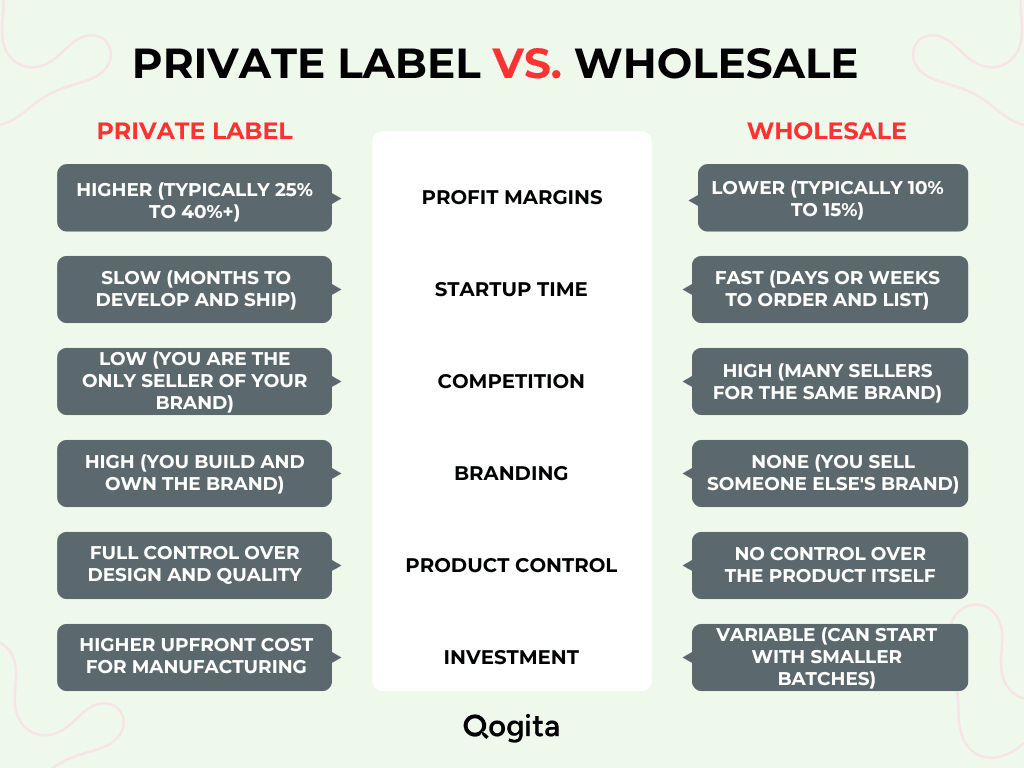
To help you decide which model fits your current situation, it is useful to see how private label vs wholesale compare across key business factors. While both can be profitable, they require a different approach to growth and management.
Profit Margins
Private label typically offers much higher profit margins. Because you buy directly from the factory, you keep the portion of the profit that would normally go to a brand owner or distributor. With wholesale, you are buying a finished product that has already passed through several hands, each taking a cut. This usually leaves you with thinner margins, often between 10% and 15%.
Time to Launch
In the fight between private label and wholesale, wholesale is the clear winner for speed. You can find a distributor, open an account, and have products listed for sale within a couple of weeks.
On the other hand, private label is a marathon. You have to research products, find a manufacturer, wait for samples, and then wait for mass production and international shipping. It is common for a private-label launch to take 3 to 6 months.
Competition levels
In the wholesale model, you often compete directly with other sellers for the same product listing. This frequently leads to price wars where everyone lowers their price to get the sale.
With a private label, you own the brand and the listing. No one else can sell your specific product, which protects you from direct price competition and allows you to maintain your price point.
Branding and Ownership
Branding and ownership are other important points of distinction between private label and wholesale, as they discuss your future.
Private label is about building an asset. You own the trademark, the logo, and the customer loyalty. If you succeed, you have a brand that you can eventually sell for a large sum. In wholesale, you are a middleman. You are helping someone else build their brand. If the brand owner decides to stop selling to you, your business for that product ends immediately.
Marketing and Advertising
Wholesale relies on "organic" demand. People are already searching for brands like LEGO or Nike, so you don't need to spend much on ads. Private label requires a heavy focus on marketing. Since nobody knows your brand exists yet, you must use advertising and social media to drive traffic to your products and convince people to buy them.
Private Label vs Wholesale: Which One Is The Right One for You?
Deciding between private label vs wholesale depends entirely on your budget, your risk tolerance, and how much time you can commit to the business. Neither model is better than the other; they simply serve different types of entrepreneurs.
If you are looking for a project that allows you to build a unique brand from scratch, go with private label. This model is right for you if you have a larger starting budget (at least €3,000 to €5,000) and the patience to wait several months for your first sale. It is a long-term play that requires a deep understanding of marketing and product development.
On the other hand, if you want to start making sales as quickly as possible with less upfront risk,wholesale might be the better path. Wholesale is ideal for those who prefer to manage logistics and supply chains rather than building a brand.
If you have a smaller budget or want to test the waters of e-commerce without the pressure of creating a new product, reselling established brands is a smart entry point.
Ultimately, you must look at your goals. Do you want to be a brand owner or a high-volume reseller? Your answer to that question will determine which model fits your lifestyle.
Private Label vs Wholesale: Common Pitfalls You Need to Avoid
Whether you choose private label vs wholesale, there are several traps that can quickly drain your budget. Success in e-commerce depends on avoiding these common mistakes that often catch new sellers off guard.
One of the most frequent pitfalls is failing to perform a rigorous quality check. Since you are responsible for the items arriving at the warehouse, skipping a third-party inspection can be a fatal mistake.
For private label, this means receiving a shipment of 500 faulty units, and for wholesale, it means buying a bulk lot of goods that turn out to be damaged. High return rates can destroy your seller metrics in just a few weeks.
Another major risk is ignoring supplier backgrounds. Many sellers rush into a deal because the price is right, without verifying if the manufacturer or distributor is legitimate. Partnering with a verified wholesale platform like Qogita can save you from fraudulent suppliers and confirm that you are sourcing authentic products from reliable sources.
Staying updated on Amazon policy changes is also critical. As of January 1, 2026, Amazon has implemented major, stricter changes to its Fulfillment by Amazon (FBA) program in the UK and globally, effectively ending its optional in-house prep and labeling services.
It means you can no longer rely on Amazon to fix labeling errors or bag your products upon arrival. Ignoring all these changes can lead to rejected shipments and heavy non-compliance fees that eat into your margins.
Finally, many sellers fail to accurately calculate the total landed cost. You must account for manufacturing prices, shipping fees, import duties, and VAT. If you only look at the base price in euros without these extras, your profit margins can disappear before you even make a sale.
Amazon Selling Models Compared: Wholesale vs Private Label
When comparing Amazon FBA wholesale vs private label, you need to look at how each model aligns with your specific seller goals. While both use Amazon's logistics network, the daily operations and long-term outcomes are quite different.
Amazon Private Label
Under this model, you create your own listing from scratch. You are responsible for keyword research, professional photography, and driving traffic through Amazon Advertising. The primary goal here is to create a unique brand that you own and can later sell. It fits sellers who want high profit margins and total control over their product's presentation.
Amazon Wholesale
The Amazon wholesale model is for those who prefer efficiency. Instead of creating a new listing, attach your offer to an existing branded listing with high sales volume. You do not need to worry about SEO or marketing because the brand name already attracts customers. This model fits sellers who want to move inventory quickly and prefer managing supply chains over brand building.
Which Model Fits Your Goals?
- For High Control and Growth: If your goal is to build a brand that lives beyond Amazon and has high exit value, consider a private label.
- For Quick Cash Flow and Low Maintenance: If you want to start generating revenue within weeks and avoid the stress of product development, wholesale is your best bet.
Real Seller Story: Running Both Wholesale and Private Label
To understand the practical side of Amazon FBA wholesale vs private label, we can look at the journey of an experienced entrepreneur who has spent over a decade in wholesale and four years building a private label brand.
This seller manages a private-label business that generates roughly €1.8 million ($2 million) annually, proving that both models can drive addictive revenue.
Insights from the Wholesale Front
In its wholesale business, this seller moved millions of products each year. The primary takeaway was the speed of the model. Wholesale allowed for profitable sales almost from day one because the demand for the brands already existed. While gross margins were lower (averaging around 20%), scaling from €1 million to €10 million in revenue is much more straightforward in wholesale.
However, the seller noted that wholesale is a "treadmill" business. You might lose a brand if they decide to stop selling to you, and it is much harder to sell a wholesale business to an investor. It functions more as a reliable cash flow machine than as a sellable asset.
Insights from the Private Label Side
Moving into Amazon's private label, the seller found this model to be much more "defensible." By registering a trademark, they ensured that no other sellers could jump on their listing. This model offered much higher gross margins, often reaching 30% to 50%.
The downside was the risk and the timeline. Launching a single product often requires waiting three months for manufacturing and shipping, plus a significant investment in Amazon Advertising (PPC) to get noticed.
Even with those challenges, the seller emphasized that established private label brands are highly attractive to buyers and can sell for substantial sums once they gain traction.
For more details about this seller’s full journey and insights, watch the YouTube video.
Conclusion
Choosing between private label vs wholesale depends on your capital and your long-term goals. Wholesale is the quickest way to start generating cash flow by reselling brands people already love and want. Private label requires more patience and a higher budget, but it allows you to build a unique brand that you own and can eventually sell.
Both approaches can work well on Amazon. The key is to look at your resources, define your goals, and choose the model that realistically fits your schedule, budget, and way of working.
Private Label Vs Wholesale FAQs
What is white label vs private label vs wholesale?
White-label involves selling a generic product manufactured by a manufacturer to multiple retailers, whereas private-label allows you to customize and brand that product exclusively. Wholesale is different from both, as you simply buy and resell existing, famous brands without making any changes to the product or packaging.
Is wholesale the same as private label?
No, they are different models. Wholesale involves reselling established brands like Nike or Puma, while private label focuses on creating and selling your own unique brand and products.
What are the disadvantages of private label?
The main drawbacks include high upfront costs for manufacturing and branding, long lead times of several months, and the heavy marketing effort required to build brand awareness from zero.
Is Amazon wholesale risky?
Wholesale carries risks such as intense price competition (the "race to the bottom"), the potential for brands to stop supplying you, and the constant need to verify product authenticity to avoid account suspension.
Can you make $10,000 a month selling on Amazon?
Yes, it is possible, but it typically requires high sales volume. For a 20% net profit margin, you would need around $50,000 in monthly revenue, which often takes 6–12 months of consistent scaling to achieve.